In the first article of this series, I gave a high-level overview of TLS handshake. It covers many complex concepts like encryption/decryptionhash functionpublic keyprivate key and digital certificate. These concepts are defined in the framework of Public Key Infrastructure (PKI).
Let’ continue exploring the PKI. This article focuses on understanding the certificates used to establish trust between clients and servers.
Symmetric plus Asymmetric
Last post examined the TLS handshake. What is remarkable in this process is both symmetric encryption and asymmetric encryption are used.
symmetric encryption and asymmetric encryption are the two broad categories of cryptographic algorithms.
Symmetric key encryption uses the same key on both sides of the communication channel to encrypt or decrypt data. In HTTPS case, the client and server agree upon new keys to use for symmetric encryption, called session key. The HTTP messages are encrypted by this symmetric session key.
It has the advantage of being very fast with low overhead. In this way, it can minimize the performance impact TLS will have on the network communications.
But the real challenge of symmetric encryption is how to keep the key private and secure! The client and server must exchange keys without letting an interested eavesdropper see them. This seems like a chicken and egg problem; you can’t establish keys over an insecure channel, and you can’t establish a secure channel without keys. Right?
This key management turns out to be the most difficult part of encryption operations and is where asymmetric or public-key cryptography enters.
Simply speaking, a secure channel is firstly established with asymmetric cryptography and then the symmetric session key is exchanged through this secure channel.
Note: Cryptography is a complex topic, which isn’t in the scope of this series of articles. You can find tons of documents on the internet about it for deeper understanding. You can regard it as a block box and ignore the details. This doesn’t influence your understanding of HTTPS in high level
Why do we need certificates
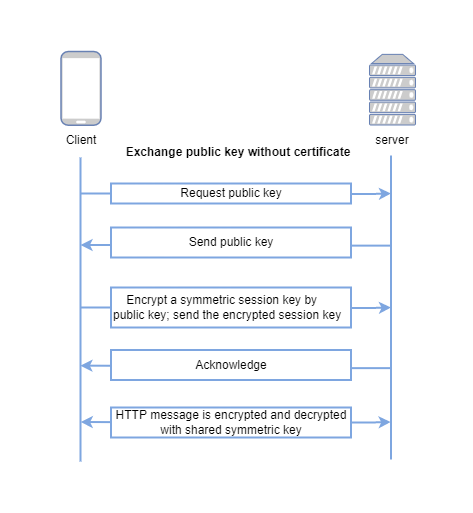
Now we know public-key cryptography is needed to establish a secure channel. Can we directly transmit the public key from servers to clients? Why do we need a certificate as the carrier to pass the public key? Can we exchange the public key without certificates as follows:
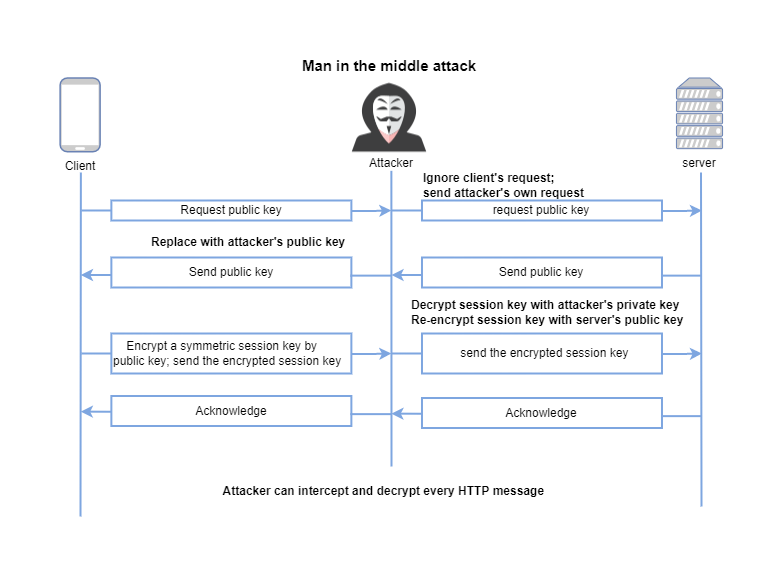
But the ultimate question is how you(as the client) know that the public key can be trusted as authentic? Assume that an attacker can not only view traffic, but also can intercept and modify it. Then the attacker can carry out man-in-the-middle attack as follows:
The attacker can replace the server’s public key with its own and send it to the client. The client doesn’t feel anything wrong and keeps using this public key as normal. The client encrypts the session key with the forged public key(the one from attackers) and sends it out. The attacker decrypts the session key with its private key, re-encrypt the session key with the server’s public key, and sends it to the server. As normal, the server decrypts the session key and agrees on it. But this session key is in the attacker’s hand too. The attacker can decrypt all the subsequent network traffic.
The problem here is that the client blindly trusts that the public key belongs to the server. That’s the reason why we need the certificates to establish trust between clients and servers.
Summary
In this article, we understand the importance of public-key cryptography and certificates. In the next article, we will take a deep look at the certificate.
At present, everybody knows about the lock icon in the browser’s address bar indicating that the session is protected by HTTPS.In this series of articles, I’ll show you how HTTPS works based on my research.
Simply speaking, HTTPS = HTTP + SSL/TLS.
In the HTTP protocol, the client communicates with the server by transmitting the message over the network. But the message is in the original format known as plaintext. The bad guys (attackers) can easily eavesdrop on the message. That’s the reason why we need SSL/TLS.
There are tons of articles online describing the relationship between SSL and TLS. You can regard TLS as the modern and advanced version of SSL. By conversion, we generally put them together as the name of the network security protocol.
In the OSI model, the HTTP protocol is in layer 7, which is at the top of protocol stacks, how about TLS protocol. Although TLS is short for Transport Layer Security, it’s not in layer 4(transport layer). You can roughly regard it as layer 5(session layer).
This means there is no nontrivial difference between HTTP and HTTPS in terms of message transmission. This series of articles will focus on the security part of HTTPS. If you want to understand HTTP itself, please read my other articles.
As the first article of this series, I will talk about how to establish an HTTPS connection. This introduces a new concept: TLS handshake.
TLS Handshake
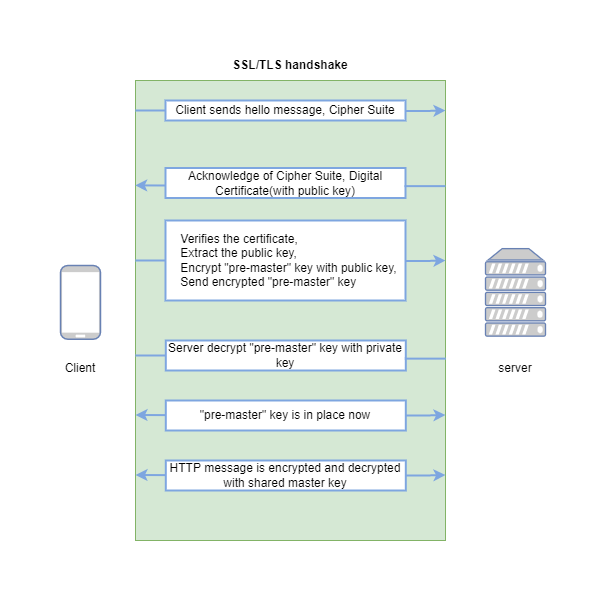
In my previous article, I wrote about TCP three way handshake to establish a TCP connection. For HTTP protocol, that’s all it needs to do. But HTTPS has to do TLS handshake as well. The process can be illustrated as follows:
Note TLS handshakes occur after a TCP connection has been opened via a TCP handshake.
Note to understand each detail of the above processing, you need to have some prerequisite knowledge such as encryption/decryption, hash function, public key, private key, and digital certificate. If you don’t know, don’t worry. After reading this series of articles, you’ll have it under your belt. In this article, I’ll go through this process roughly and ignore the detail of each step.
Client hello message: the client starts the handshake by sending a “hello” message to the server. This “hello” message includes the TLS version and the cipher suites supported on the client-side. cipher suites is a fancy name for the set of encryption algorithms for use in establishing a secure connection.
Server hello message: the server chooses the best(or suitable) SSL/TLS version and encryption algorithm among the candidates sent by the client. The server’s chosen cipher suite and certificate are sent to the client. certificate makes SSL/TLS encryption possible, which is critical to understand the entire process. For now, you need to know certificates contain the server’s public key which is sent to the client. And the private key is kept secret on the server.
Authentication: The client verifies the server’s certificate (I’ll investigate the certificate verification process at a very detailed level in another article).
Encrypt the pre-master key: The client generates one random “pre-master” key, encrypts “pre-master” key with the server’s public key (extract from the certificate) and sends the encrypted “pre-master” key to the server.
Decrypt the pre-master key: The server decrypts the “pre-master” key with its private key (The premaster key is encrypted with the public key and can only be decrypted with the private key by the server. This is called asymmetric encryption).
Session key created: Both client and server will generate a session key based on the “pre-master” key. The session key should be the same on both sides.
HTTP message encryption: Until the last step, the handshake is completed. The client and server will use the agreed session key to encrypt the following HTTP messages and continue the communication (since both sides use the same key, this is called symmetric encryption).
That’s all about TLS handshake process.
Summary
As the first article of this series, I go through the entire process of TLS handshake. In future articles, I’ll show you the mysteries of each part.
In TCP/IP protocol stack, the three way handshake for connection establishment and four way handshake for connection termination are some concepts you must understand.
But after I learned TCP/IP stack, one question coming to my mind is why the connection termination needs four-way handshake. In this article, I will focus on this topic. To understand the answer to this question, we need to first explain the details of these two processes and compare them to find the difference.
TCP connection establishment
In contrast to UDP, TCP is a connection-oriented and reliable full duplex protocol, which requires a logical connection to be established between the two processes before data is exchanged. The connection must be maintained during the entire process that communication is taking place. And in TCP both sides can send data to its peer.
So four things need to happen for fully establishing a TCP connection:
Each node has send a SYN flag to its peer (that’s two things, one SYN in each direction)
Each node has received a ACK flag of its own SYN flag from its peer (that’s two things)
Both SYN and ACK are properties in TCP header, where SYN means synchronization and ACK means acknowledgement. In detail the process goes as follows:
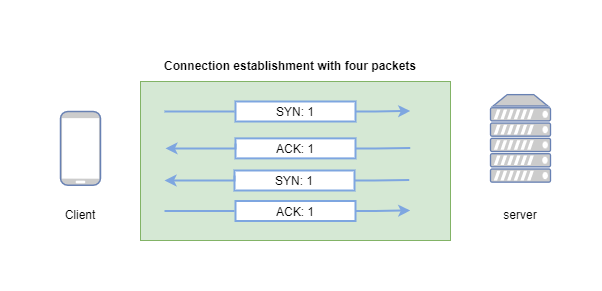
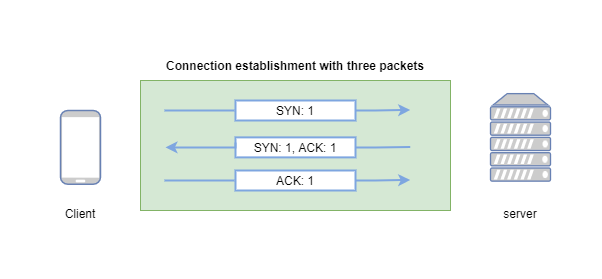
Firstly, the client sends the SYN: 1 packet to server to start the connection. When the server receives the packet, it will send the ACK: 1 packet to client to confirm that. Since in the TCP protocol, the server can also send data to the client. So the server needs to send the SYN: 1 packet to the client as well. Finally, when the client sends the ACK: 1 packet to the server. The establishment process is done, which goes as follows:
Note that the server sends two packets: ACK: 1 and SYN: 1 in sequence. Why not combine these two packets into one to have a better network performance? So the common implementation of TCP protocol goes as follows:
Note: besides SYN and ACK flag, in the establishment stage there are other fields need to be set in TCP header such as: sequence number and window. I will discuss these important TCP header fields in other articles.
TCP connection termination
When the data stream transportation (I will not cover this part in this article) is over, we need to terminate the TCP connection.
Same as above, four things need to happen for fully terminating a TCP connection:
Each node has send a FIN flag to its peer (that’s two things, one FIN in each direction)
Each node has received a ACK flag of its own FIN flag from its peer (that’s two things)
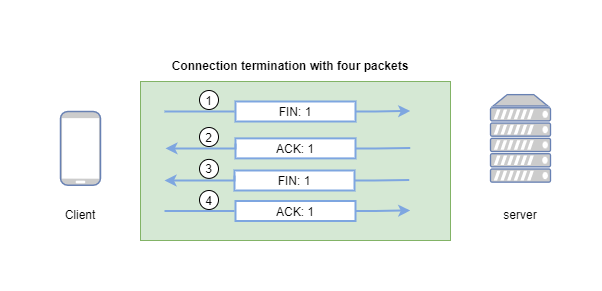
But the difference is that in most TCP implementation, four packets are used to terminate the connection. We didn’t combine the ACK: 1 packet (marked as ②) and the FIN: 1 packet (marked as ③) into one packet.
The reason is ACK: 1 packet (marked as ②) is send by TCP stack automatically. And the next FIN: 1 packet (marked as ③) is controlled in application level by calling close socket API. Application has the control to terminate the connection. So in common case, we didn’t merge this two packets into one.
It’s flexible for the application to control this process, for example, in this way the application can reuse existing TCP connection to reduce the overhead and improve the performance. In next article, I will talk about this topic.
In this article, I will focus on the topic of data structure and algorithms (in my eyes, one of the most important skills for software engineers). Someday I came across one question goes like this: how can building a heap be O(n) time complexity? This question confuses me for a while, so I did some investigation and research on it. This article will share what I learned during this process, which covers the following points:
What is a heap data structure? How does a heap behave?
How to implement a heap in C programming?
How to do the time complexity analysis on building the heap?
Basics of Heap
Before we dive into the implementation and time complexity analysis, let’s first understand the heap.
As a data structure, the heap was created for the heapsort sorting algorithm long ago. Besides heapsort, heaps are used in many famous algorithms such as Dijkstra’s algorithm for finding the shortest path. Essentially, heaps are the data structure you want to use when you want to be able to access the maximum or minimum element very quickly.
In computer science, a heap is a specialized tree-based data structure. A common implementation of a heap is the binary heap, in which the tree is a binary tree.
So a heap can be defined as a binary tree, but with two additional properties (that’s why we said it is a specialized tree):
shape property: a binary heap is a complete binary tree. So what is a complete binary tree? That is all levels of the tree, except possibly the last one(deepest) are fully filled, and, if the last level of the tree is not complete, the nodes of that level are filled from left to right. The complete binary tree is one type of binary tree, in detail, you can refer to this document to learn more about it.
Heap property: the key stored in each node is either greater than or equal to (max-heaps) or less than or equal to (min-heaps) the keys in the node’s children.
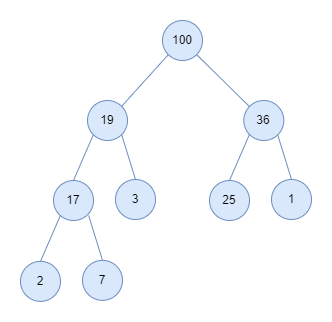
The following image shows a binary max-heap based on tree representation:
The heap is a powerful data structure; because you can insert an element and extract(remove) the smallest or largest element from a min-heap or max-heap with only O(log N) time. That’s why we said that if you want to access to the maximum or minimum element very quickly, you should turn to heaps. In the next section, I will examine how heaps work by implementing one in C programming.
Note: The heap is closely related to another data structure called the priority queue. The priority queue can be implemented in various ways, but the heap is one maximally efficient implementation and in fact, priority queues are often referred as “heaps”, regardless of how they may be implemented.
Implementation of Heap
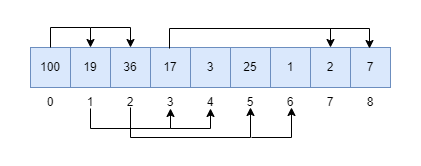
Because of the shape property of heaps, we usually implement it as an array, as follows:
Each element in the array represents a node of the heap.
The parent/child relationship can be defined by the elements’ indices in the array. Given a node at index i, the left child is at index 2*i + 1 and the right child is at index 2*i + 2, and its parent is at index ⌊(i-1)/2⌋ (⌊⌋ means Floor operation).
Based on the above model, let’s start implementing our heap. As we mentioned, there are two types of heaps: min-heap and max-heap, in this article, I will work on max-heap. The difference between max-heap and min-heap is trivial, you can try to write out the min-heap after you understand this article.
The completed code implementation is inside this Github repo.
First, let’s define the interfaces of max-heap in the header file as follows:
We define the max-heap as struct _maxheap and hide its implementation in the header file. And expose this struct in the interfaces via a handler(which is a pointer) maxheap. This technique in C program is called opaque type. Opaque type simulates the encapsulation concept of OOP programming. So that the internal details of a type can change without the code that uses it having to change. The detailed implementation goes as following:
1
2
3
4
5
6
// maxheap.c file
struct _maxheap {
	key_type* array;
	int max_size;
	int cur_size;
};
The max-heap elements are stored inside the array field. The capacity of the array is defined as field max_size and the current number of elements in the array is cur_size.
Next, let’s go through the interfaces one by one (most of the interfaces are straightforward, so I will not explain too much about them). The first one is maxheap_create, which constructs an instance of maxheap by allocating memory for it.
Don’t forget to release the allocated memory by calling free.
Next, let’s work on the difficult but interesting part: insert an element in O(log N) time. The solution goes as follows:
Add the element to the end of the array. (The end of the array corresponds to the leftmost open space of the bottom level of the tree).
Compare the added element with its parent; if they are in the correct order(parent should be greater or equal to the child in max-heap, right?), stop.
If not, swap the element with its parent and return to the above step until reaches the top of the tree(the top of the tree corresponds to the first element in the array).
The first step of adding an element to the array’s end conforms to the shape property first. Then the heap property is restored by traversing up the heap. The recursive traversing up and swapping process is called heapify-up. It is can be illustrated by the following pseudo-code:
1
2
3
4
5
6
Max-Heapify-Up(A, i):
    parent ← (i - 1) / 2

    if parent >= 0 and A[parent] < A[i] then:
        swap A[i] and A[parent]
        Max-Heapify-Up(A, parent)
h->cur_size += 1; // make sure there is space if (h->cur_size == h->max_size) { maxheap_double_capacity(h); }
// add at the end h->array[h->cur_size] = key; // restore the heap property by heapify-up maxheap_heapifyup(h, h->cur_size);
}
The number of operations requried in heapify-up depends on how many levels the new element must rise to satisfy the heap property. So the worst-case time complexity should be the height of the binary heap, which is log N. And appending a new element to the end of the array can be done with constant time by using cur_size as the index. As a result, the total time complexity of the insert operation should be O(log N).
Similarly, next, let’s work on: extract the root from the heap while retaining the heap property in O(log N) time. The solution goes as follows:
Replace the first element of the array with the element at the end. Then delete the last element.
Compare the new root with its children; if they are in the correct order, stop.
If not, swap the element with its child and repeat the above step.
This similar traversing down and swapping process is called heapify-down. heapify-down is a little more complex than heapify-up since the parent element needs to swap with the larger children in the max heap. The implementation goes as follows:
staticvoidmaxheap_heapifydown(maxheap h, int k) { assert(h); while(2*k <= h->cur_size) { int j = 2*k; if (j<h->cur_size && h->array[j+1] > h->array[j]) { j++; } if (h->array[k] >= h->array[j]) { break; } maxheap_swap(h, k, j); k = j; } }
intmaxheap_findmax(maxheap h) { if (maxheap_is_empty(h)) { fprintf(stderr, "Heap is empty!\n"); abort(); }
// max is the first position return h->array[0]; }
voidmaxheap_deletemax(maxheap h) { if (maxheap_is_empty(h)) { fprintf(stderr, "Heap is empty!\n"); abort(); } // swap the first and last element maxheap_swap(h, 0, h->cur_size); h->cur_size -= 1; maxheap_heapifydown(h, 0); }
Based on the analysis of heapify-up, similarly, the time complexity of extract is also O(log n).
In the next section, let’s go back to the question raised at the beginning of this article.
The time complexity of building a heap
What’s the time complexity of building a heap? The first answer that comes to my mind is O(n log n). Since the time complexity to insert an element is O(log n), for n elements the insert is repeated n times, so the time complexity is O(n log n). Right?
We can use another optimal solution to build a heap instead of inserting each element repeatedly. It goes as follows:
Arbitrarily putting the n elements into the array to respect the shape property.
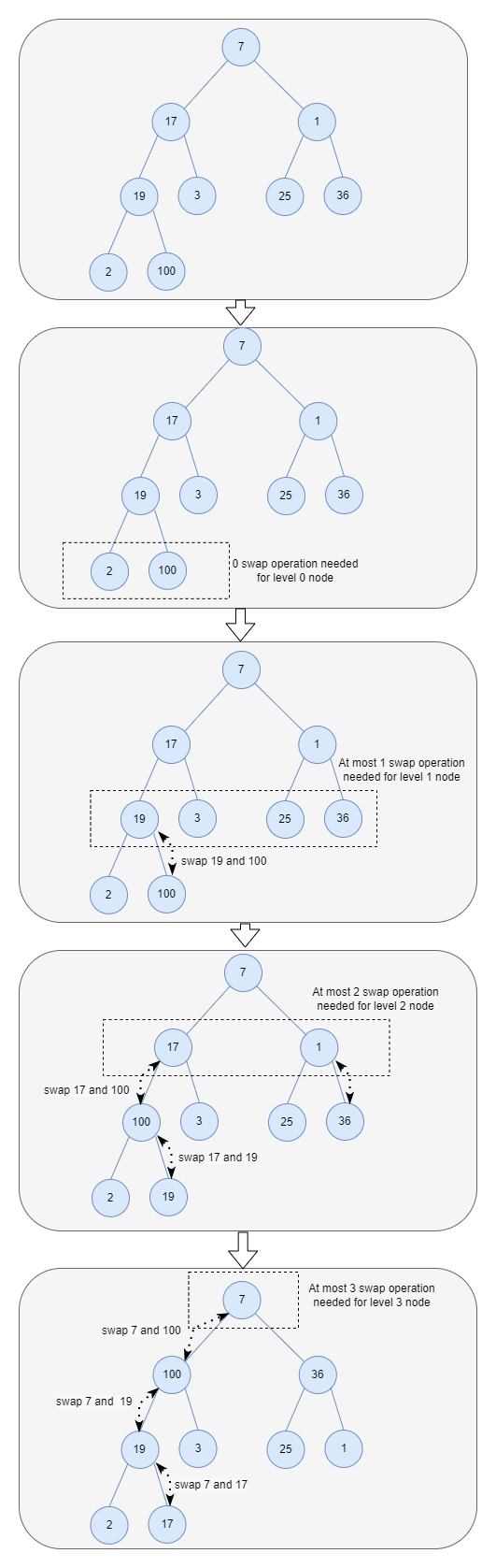
Starting from the lowest level and moving upwards, sift the root of each subtree downward as in the heapify-down process until the heap property is restored.
This process can be illustrated with the following image:
maxheap maxheap_heapify(const key_type* array, int n) {
	assert(array && n > 0);

	maxheap h = (maxheap)malloc(sizeof(struct _maxheap));
	if(h == NULL) {
		fprintf(stderr, "Not enough memory!\n");
		abort();
	}
	h->max_size = n;
	h->cur_size = -1;
	h->array = (key_type*)(malloc(sizeof(key_type)*h->max_size));
	if(h->array == NULL) {
		fprintf(stderr, "Not enough memory!\n");
		abort();
	}
	h->cur_size = n-1;
	for (int i=0; i< n; i++) {
		h->array[i] = array[i];
	}
	// small trick here. don't need start the loop from the end
	for (int i = h->max_size/2; i >= 0; i--) {
		maxheap_heapifydown(h, i);
	}
	return h;
}
Next, let’s analyze the time complexity of this above process. Suppose there are n elements in the heap, and the height of the heap is h (for the heap in the above image, the height is 3). Then we should have the following relationship:
2h<=n<=2h+1−1
When there is only one node in the last level then n=2h. And when the last level of the tree is fully filled then n=2h+1−1
And start from the bottom as level 0 (the root node is level h), in level j, there are at most 2h−j nodes. And each node at most takes j times swap operation. So in level j, the total number of operation is j∗2h−j.
So the total running time for building the heap is proportional to:
T(n)=j=0∑hj∗2h−j=j=0∑hj∗2j2h
If we factor out the 2h term, then we get:
T(n)=2hj=0∑h2jj
As we know, j=0∑∞2jj is a series converges to 2 (in detail, you can refer to this wiki).
Using this we have:
T(n)=2hj=0∑h2jj<=2hj=0∑∞2jj<=2h∗2=2h+1
Based on the condition 2h<=n, so we have:
T(n)<=2n=O(n)
Now we prove that building a heap is a linear operation.
Summary
In this article, we examined what is a Heap and understand how it behaves(heapify-up and heapify-down) by implementing it. More importantly, we analyze the time complexity of building a heap and prove it’s a linear operation.